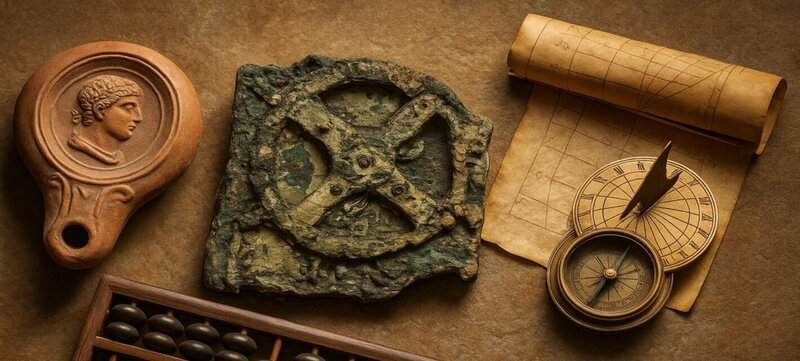
Ancient Technologies That Were Ahead of Their Time. When people think about advanced technology, they often picture modern inventions like computers, satellites, or artificial intelligence. However, many ancient civilizations developed technologies so advanced that they continue to amaze scientists and historians today. These innovations were often far ahead of their time, demonstrating a deep understanding of engineering, astronomy, medicine, mathematics, and materials science.
This detailed article explores remarkable ancient technologies that challenged historical assumptions, explains how they worked, and shows why they still matter in the modern world.
What Is Meant by Ancient Technology
Ancient technology refers to tools, machines, systems, and methods developed by early civilizations using the knowledge and resources available at the time.
Characteristics of Advanced Ancient Technologies
- Practical problem-solving solutions
- Sophisticated engineering without modern machines
- Use of natural materials in innovative ways
- Long-lasting durability
- Precision and standardization
Many of these technologies were forgotten for centuries and only rediscovered through archaeology.
Why Ancient Technologies Were So Advanced
Ancient innovations were driven by necessity, observation, and experimentation rather than theoretical science.
Factors That Enabled Innovation
- Close observation of nature and astronomy
- Skilled craftsmanship passed down through generations
- Strong emphasis on mathematics and geometry
- Large-scale cooperation and organization
- Trial-and-error experimentation over centuries
These factors allowed ancient societies to create technologies that rival modern engineering in effectiveness.
The Antikythera Mechanism
Overview of the Device
The Antikythera Mechanism was discovered in a Greek shipwreck in 1901 and dates back to around 100 BCE.
Why It Was Ahead of Its Time
The mechanism consisted of complex bronze gears designed to predict astronomical events such as eclipses, planetary movements, and Olympic cycles.
How It Worked
- Interlocking gears calculated celestial positions
- Manual rotation powered the system
- Accurate predictions based on mathematical ratios
Why It Matters Today
Often described as the world’s first analog computer, it proved that ancient Greeks possessed advanced mechanical and astronomical knowledge.
Roman Concrete
Overview of Roman Concrete
Roman concrete, used over 2,000 years ago, remains stronger and more durable than many modern concrete structures.
Why It Was Ahead of Its Time
Roman builders created a self-healing concrete mixture using volcanic ash, lime, and seawater.
Key Features
- Resistant to cracking
- Strengthened over time
- Ideal for marine environments
Modern Relevance
Modern engineers study Roman concrete to develop more sustainable and durable construction materials.
Ancient Water Management Systems
Aqueducts of Ancient Rome
Roman aqueducts transported water over long distances using gravity alone.
Why They Were Advanced
- Precise gradient calculations
- Durable materials and arches
- Continuous water flow for cities
Other Advanced Systems
Qanat System in Persia
Underground channels transported water across deserts without evaporation.
Indus Valley Drainage
Cities like Mohenjo-Daro featured covered drainage and household plumbing.
Modern Relevance
These systems influenced modern plumbing, irrigation, and urban water management.
Ancient Surgical Techniques
Early Medical Innovations
Ancient civilizations performed complex surgeries long before modern anesthesia or sterilization.
Examples of Advanced Medicine
Ancient India
Texts described procedures like cataract surgery and reconstructive surgery.
Ancient Egypt
Medical papyri documented treatments, wound care, and surgical tools.
Why This Was Ahead of Its Time
- Specialized instruments
- Knowledge of anatomy
- Use of antiseptic substances
Modern Relevance
Many foundational medical practices originated from ancient experimentation.
The Baghdad Battery
Overview of the Discovery
The Baghdad Battery consists of clay jars with copper and iron components, dating back to around 200 BCE.
Why It Was Ahead of Its Time
Some researchers believe it functioned as a simple electric battery.
Possible Uses
- Electroplating metals
- Religious or ritual purposes
- Chemical experiments
Why It Matters
If confirmed, it suggests an ancient understanding of electricity centuries before modern science.
Ancient Astronomical Observatories
Stonehenge
Stonehenge in England aligns with solstices and celestial events.
Maya Observatories
The Maya accurately tracked planetary movements and created complex calendars.
Why These Were Advanced
- Precise alignment with astronomical cycles
- Long-term observations
- Mathematical accuracy
Modern Relevance
These observatories show early scientific thinking and understanding of astronomy.
Greek Fire
Overview of Greek Fire
Greek Fire was an incendiary weapon used by the Byzantine Empire.
Why It Was Ahead of Its Time
- Burned on water
- Difficult to extinguish
- Highly effective in naval warfare
Mystery of Its Formula
The exact composition remains unknown, making it one of history’s greatest technological secrets.
Impact on Warfare
Greek Fire gave the Byzantines a decisive military advantage for centuries.
Ancient Road Networks
Roman Roads
Romans built over 400,000 kilometers of roads across their empire.
Why They Were Advanced
- Multi-layer construction
- Drainage systems
- Durability lasting thousands of years
Inca Road System
The Inca built roads across mountains using stone staircases and suspension bridges.
Modern Relevance
These networks influenced modern transportation infrastructure and logistics.
Ancient Timekeeping Devices
Water Clocks
Used in Egypt, Greece, and China to measure time accurately.
Sundials
Provided precise timekeeping based on solar movement.
Why They Were Advanced
- Standardized measurement of time
- Used for governance, religion, and science
Modern Relevance
These devices laid the foundation for modern clocks and calendars.
Ancient Metallurgy
Damascus Steel
Famous for its strength, flexibility, and distinctive patterns.
Why It Was Ahead of Its Time
- Superior carbon structure
- Exceptional durability
- Advanced forging techniques
Other Metallurgical Advances
- Bronze alloys
- Gold refining
- Ironworking techniques
Modern Relevance
Ancient metallurgy influences modern materials science.
Ancient Mechanical Automata
Self-Moving Machines
Ancient Greeks designed mechanical devices powered by water, air, or weights.
Examples
- Automatic doors in temples
- Moving statues
- Coin-operated machines
Why They Were Advanced
These devices demonstrated an understanding of mechanics and automation.
Modern Relevance
They represent early forms of robotics and mechanical engineering.
Ancient Navigation Tools
Astrolabe
Used to determine latitude and celestial positions.
Polynesian Navigation
Navigators used stars, ocean currents, and wind patterns to cross vast oceans.
Why They Were Advanced
- Accurate long-distance navigation
- No modern instruments required
Modern Relevance
These tools influenced maritime exploration and global trade.
Why Ancient Technologies Were Lost
Collapse of Civilizations
Wars, invasions, and political decline led to the loss of knowledge.
Lack of Written Records
Some technologies were passed orally and disappeared when cultures collapsed.
Technological Shifts
New materials or methods replaced older technologies.
Lessons Ancient Technologies Teach Us Today
Innovation Does Not Require Modern Tools
Creativity and observation can lead to extraordinary solutions.
Sustainability Matters
Many ancient technologies were environmentally friendly and long-lasting.
Knowledge Can Be Forgotten
Preserving knowledge is as important as creating it.
Frequently Asked Questions
Were ancient technologies really advanced
Yes. Many ancient technologies rival modern solutions in efficiency and durability.
Why didn’t ancient civilizations industrialize
Limited energy sources, social structures, and economic systems restricted mass production.
Are ancient technologies still used today?
Many principles, such as aqueducts, concrete, and navigation methods, are still applied.
Did ancient people understand science?
They understood practical science through observation, mathematics, and experimentation.
Can ancient technologies inspire modern innovation
Absolutely. Engineers and scientists continue to study ancient solutions for sustainable design.
Final Thoughts
Ancient technologies that were ahead of their time prove that human ingenuity is not limited by era. Long before modern machinery, ancient civilizations developed sophisticated solutions to complex problems using observation, mathematics, and craftsmanship. These innovations shaped human progress and continue to influence modern science, engineering, medicine, and architecture.
By studying ancient technologies, we gain not only admiration for early civilizations but also valuable lessons for creating smarter, more sustainable solutions today. The past, far from being primitive, often holds the keys to the future.